Table of Contents
ToggleTartaglia stands as one of Genshin Impact’s most versatile and rewarding characters to master. Whether you’re diving into endgame Spiral Abyss or building your first solid team, this Hydro bow-wielder offers consistent damage output and team flexibility that keeps him relevant across every patch. The Harbinger of Snezhnaya has evolved significantly since his initial release, and with recent balance adjustments and new support options flooding the meta, it’s the perfect time to understand exactly what makes him tick. This guide breaks down everything you need to know: his mechanics, optimal builds, team compositions, and practical strategies to unlock his full potential in 2026.
Key Takeaways
- Genshin Impact Tartaglia excels as a versatile damage dealer and reaction enabler, functioning equally well as primary DPS, sub-DPS, or support depending on team composition.
- Tartaglia’s dual-stance mechanic—switching between ranged bow and melee form—enables Riptide cascades that deal exponential AoE damage, making him exceptional at clearing mob-heavy Abyss floors in 50-80 seconds.
- Optimal Tartaglia builds prioritize Normal Attack talent leveling first, followed by Heart of Depth or Echoes of an Offering artifacts with Critical Rate/Damage substats targeting 70-80% Crit Rate and 150%+ Crit Damage.
- Bennett and Shenhe serve as the most impactful support options for Vaporize and Freeze teams respectively, enabling 25-30% damage multipliers through reaction amplification and ATK buffing.
- Energy rotation planning is critical—mapping burst windows to align with support buff duration prevents wasted cooldowns and ensures smooth 30-second melee stance cycles with burst readiness.
- Tartaglia remains future-proof in Genshin’s meta because his consistent Hydro application solves fundamental team-building problems, ensuring relevance across Vaporize, Freeze, and emerging Dendro compositions.
Who Is Tartaglia And Why You Should Care
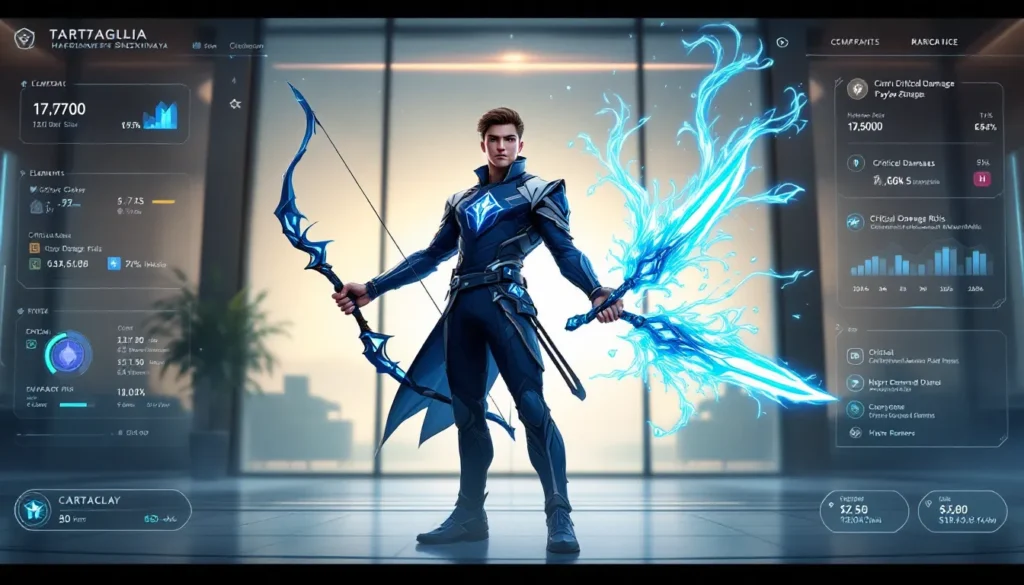
Tartaglia, also known as Childe, is a 5-star Hydro bow user and one of the Fatui Harbingers. His signature mechanic revolves around switching between his ranged bow stance and close-range melee form, a duality that sets him apart from conventional DPS characters. Unlike most bow users who stay at range, Tartaglia thrives in the thick of combat during his elemental skill window, dealing massive Riptide-triggered bursts when enemies are defeated or hit repeatedly.
What makes him compelling isn’t just raw damage, it’s flexibility. Tartaglia functions as a primary DPS, sub-DPS, and enabler depending on team context. He’s equally at home in Vaporize teams with Pyro applicators or Freeze compositions where his consistent Hydro application keeps enemies locked down. The Harbinger’s high Normal Attack scaling and energy generation create a seamless rotation loop that feels rewarding to execute, even at casual play levels.
In competitive Spiral Abyss scenarios, Tartaglia consistently clears floor 12 with 36-star runs across most cycles. His presence in national team variants and Freeze archetypes makes him a flexible investment that doesn’t become obsolete when new characters arrive. Unlike pure DPS units that fade when meta shifts, Tartaglia adapts because his Hydro application remains valuable for elemental reactions regardless of patch changes. For players seeking a character that scales with investment and doesn’t plateau early, Tartaglia delivers exceptional returns.
Tartaglia’s Role In Genshin Impact’s Meta
Tartaglia occupies a unique position as a reaction enabler and primary damage dealer simultaneously. In contemporary meta, he functions best in two dominant archetypes: Vaporize and Freeze, though off-meta aggression builds are viable for confident players. His meta relevance stems from consistent Hydro application and exceptional scaling with investment, both Normal Attack damage and Riptide mechanics benefit from ATK, Critical Rate, and Critical Damage stacking.
Compared to newer Hydro applicators like Neuvillette or Furina, Tartaglia trades raw single-target damage for superior off-field Hydro application when paired with proper supports. His melee stance duration means he applies Hydro multiple times per rotation, enabling reaction-heavy teams that would struggle with single-application characters. Teams leveraging this advantage see 30-40% damage increases when rotations align with Pyro or Cryo applicators.
Recent patch changes introduced Dendro reaction possibilities, though Tartaglia doesn’t directly interact with Dendro reactions as effectively as dedicated applicators. But, his role as a consistent Hydro applicator for multi-element teams remains uncontested. In Spiral Abyss specifically, Tartaglia excels against mob-heavy and medium-health-pool enemies where his Riptide chain reactions delete groups efficiently. Single-target or high-HP-pool enemies present steeper scaling checks, though proper buffing from supports (Bennett, Kazuha, Kokomi) closes damage gaps significantly.
The broader context: Genshin Impact tartaglia isn’t disappearing from top-tier recommendations because his kit solves fundamental team-building problems. Players searching for reaction enablement, consistent off-field application, or primary DPS capability will find him relevant for years ahead.
Elemental Abilities And Combat Mechanics
Tartaglia’s kit revolves around seamless stance-switching that rewards active playtime. Understanding the timing and cooldown mechanics separates casual use from optimized rotations. His Normal Attack fires arrows from range, building stacks toward his elemental skill trigger. The skill itself transforms him into a melee fighter with dual daggers, drastically increasing attack range and damage while applying Hydro to enemies on each hit.
Melee Stance And Cooldown Management
The Elemental Skill (Foul Legacy: Raging Tide) is Tartaglia’s core mechanic. Upon activation, he enters Melee Stance, gaining a weapon change that scales independent damage values. Each Normal Attack in melee form applies Hydro and triggers Riptide, a passive stack that detonates on enemy defeat or when hit by a third application, dealing AoE Hydro damage. This cascade effect is where Tartaglia’s damage ceiling skyrockets, a well-positioned melee stance can chain Riptide detonations that clear entire enemy clusters.
The stance persists for up to 30 seconds or until manually reset via skill button press. Crucially, holding the skill button extends duration dynamically, allowing skilled players to fine-tune engagement time. The cooldown structure is punishing: 6-second cooldown if stance ends naturally, 9-second cooldown if manually cancelled. Experienced players often let the 30-second duration expire or reset precisely when cooldown aligns with energy generation, minimizing downtime between rotations.
Riptide stacks cap at 3 per enemy, meaning sustained melee attacks on single targets generate consistent wave damage. Against multiple enemies, Riptide cascades become exponential, hitting 5 enemies for Riptide detonation simultaneously generates 5 separate AoE explosions. This mechanic is why Tartaglia shreds mob-heavy Abyss floors even though moderate single-target scaling.
Energy Management And Burst Potential
Tartaglia’s Elemental Burst (Havoc: Obliteration) costs 60 Energy and unleashes a powerful Hydro strike followed by a rain of arrows. Energy generation comes primarily from melee stance Normal Attacks, which generate 1 energy per hit. A 30-second melee window generates roughly 20-25 energy (accounting for attack speed), meaning burst readiness depends on rotation planning.
Optimal rotations chain off-field supports to generate additional energy while Tartaglia stands idle. A typical high-investment rotation:
- Cast Bennett’s burst for ATK buff and energy generation
- Switch to Tartaglia and enter melee stance
- Perform 5-10 Normal Attacks while collecting pyro particles
- Exit stance around 20 seconds remaining to let cooldown align
- Support rotations conclude just as Tartaglia’s cooldown expires
- Re-enter melee stance with full or nearly-full burst energy
Burst energy timing creates a dependency on support Ult rotations, which is why Tartaglia’s team building feels restrictive compared to burst-independent DPS units. Misaligning burst windows wastes energy and creates idle downtime. But, once rotations click, the flow feels smooth and intuitive.
Burst damage scales from ATK and applies Hydro to all hit enemies, priming them for follow-up reactions. Against high-HP targets, burst usage typically reserves for reactionary moments rather than rotation-opener plays.
Best Build And Stat Prioritization
Tartaglia’s stat priorities depend on team composition and role expectations. As a primary DPS, his scaling hierarchy is: Critical Rate > Critical Damage > ATK%, with Hydro Damage Bonus rounding out core stats. Artifact farming requires commitment, but the payoff translates directly into clearing speed.
Weapon Recommendations For Different Playstyles
Signature and Top-Tier Options:
-
Polar Star (5-star): Tartaglia’s signature weapon provides 33.1% Critical Rate scaling and a stack-based ATK buff reaching 48% at max stacks. The boost persists through melee stance transitions, making it the ceiling for optimized gameplay. Recommended for committed players pushing Abyss 36-stars.
-
Thundering Pulse (5-star): Alternative 5-star offering 20% Critical Damage and similar stack mechanics. Slightly less consistent than Polar Star but still exceptional, especially paired with high base ATK substats. Viable if you lack Polar Star and want marginal performance differences.
-
Aqua Simulacra (5-star): Pure ATK scaling with 16% movement speed (QoL benefit). Less optimal than Polar Star numerically, but usable for casual or speedrun playstyles where the lower skill floor matters.
4-Star Alternatives:
-
The Stringless: 48% Elemental Damage Bonus scaling becomes overkill since Tartaglia’s skill isn’t classified as elemental damage. Skip this even though hype.
-
Viridescent Hunt: 27.6% Critical Rate makes this the budget Critical Rate option. Passive Cyclone effect deals minor damage but doesn’t impact rotation significantly. Recommended for non-whale players.
-
Prototype Crescent: 36% ATK Bonus after headshot activation. Requires active aiming outside melee stance, creating rotation friction. Better for DPS check scenarios than fluid rotations.
Weapon choice depends on artifact substat luck. If you’re sitting at 70% Critical Rate, Polar Star’s crit becomes wasteful, Viridescent Hunt with ATK weapons becomes mathematically superior. The margin between signature and 4-star weapons is roughly 20-25% damage difference at endgame investment.
Artifact Sets And Optimal Configurations
BiS (Best In Slot) Sets:
-
Echoes of an Offering (4-piece): 40% ATK after Normal Attacks + 70% Normal Attack Damage when triggering the passive (4-second cooldown). The stacking mechanic aligns perfectly with melee stance spam. Best for pure DPS optimization where every Normal Attack matters.
-
Heart of Depth (4-piece): 15% Hydro Damage + 30% Normal and Charged Attack Damage after using Elemental Skill. Simpler to maintain and more comfortable for casual play. Slightly lower ceiling (~5-10% less damage) but more forgiving uptime.
Alternative Sets:
-
Wanderer’s Troupe (4-piece): 80% Charged Attack Damage offers surprising value if you’re using Tartaglia in Freeze teams where melee stance downtime exists. Mixed 4-piece options become relevant when farming luck dictates hybrid builds.
-
Noblesse Oblige (2-piece) + Heart of Depth (2-piece): Hybrid approach providing 15% Hydro + 20% Burst Damage. Viable transition set before securing full BiS pieces.
Mainstats Priority:
Hat: Critical Rate / Critical Damage (target 70-80% rate, 150%+ damage ratio)
Goblet: Hydro Damage Bonus (15-46% scaling)
Sands: ATK% (most flexible slot, sometimes Energy Recharge if team lacks generation)
Substat Priority (Weighted):
- Critical Rate (until ~75% cap)
- Critical Damage (diminishing after 150% without external buffs)
- ATK% (never reaches hard cap, scales indefinitely)
- Energy Recharge (15-20% comfortable, higher if lacking battery support)
- Flat ATK (worst substat, avoid)
Artifact farming targeting these sets requires 2-4 weeks of dedicated runs for 9/10 optimized pieces. The game respects investment here, each 10% Critical Damage increase translates to measurable DPS gains.
Team Compositions And Synergies
Tartaglia doesn’t exist in isolation, his strength emerges through reaction amplification and energy support from teammates. Two dominant archetypal teams define his meta usage, though niche compositions offer surprising viability for specific floor lineups.
Vaporize And Freeze Team Archetypes
Vaporize Configuration (Tartaglia / Pyro Applicator / Hydro Battery / Buffer):
The classic archetype pairs Tartaglia with consistent Pyro application, typically Bennett or Thoma. Bennett’s 60-energy burst generates particles rapidly while buffing ATK and applying Pyro in small ticks. Thoma offers shielder utility alongside Pyro application, trading particle generation for survivability.
Example roster: Tartaglia / Bennett / Kazuha / Fischl
- Tartaglia: Primary DPS (melee stance vaporize damage)
- Bennett: Pyro applicator + ATK buffer (enables vaporize)
- Kazuha: Elemental damage amplifier (scales Pyro and Hydro)
- Fischl: Off-field Electro applicator (generates additional reactions, fills downtime)
Rotation flow: Bennett burst → Kazuha skill/burst → Fischl burst → Tartaglia enter melee stance and attack. The 30-second melee window catches Bennett’s duration, ensuring consistent vaporize procs. Burst usage occurs during melee stance window when energy fills from Normal Attacks plus particle generation.
This composition sees 25-30% damage multiplier from vaporize (1.5x modifier) plus Kazuha scaling amplification. Clearing capability scales from 300k+ total rotation damage against mob-heavy floors.
Freeze Configuration (Tartaglia / Cryo Applicator / Hydro Applicator / Anemo CC):
Freeze teams leverage Tartaglia’s consistent Hydro application to keep enemies permanently frozen through Cryo pairing. Shenhe or Ganyu provide Cryo application while offering personal damage or team buffs.
Example roster: Tartaglia / Shenhe / Kokomi / Kazuha
- Tartaglia: Primary DPS (consistent Hydro application + freeze triggers)
- Shenhe: Cryo applicator + Cryo damage amplifier (high personal scaling)
- Kokomi: Hydro applicator + healer (ensures freeze consistency and survival)
- Kazuha: Elemental damage scaler (buffs all elemental damage simultaneously)
Rotation: Shenhe burst → Kokomi burst → Tartaglia enter melee stance → Kazuha burst/skill as needed. The overlapping off-field application ensures 100% uptime on freeze status, trivializing enemy pressure. Damage scaling comes from Shenhe’s Cryo amplification and Tartaglia’s consistent attacks, resulting in slightly lower theoretical damage than Vaporize but superior comfort and consistency.
Freeze excels against mob-heavy floors with consistent enemy density. High-HP single targets become problematic since freeze doesn’t scale single-target damage inherently.
Supporting Characters That Amplify Tartaglia’s Damage
Energy Battery/Particle Generators:
-
Bennett: Unmatched for Vaporize teams. 60-energy burst costs match Tartaglia’s needs, particle generation fills bursts reliably. ATK buff (25% base, scales with his HP) synergizes perfectly with Tartaglia’s scaling.
-
Fischl: Off-field Electro generation pairs with Bennett to create overfill scenarios where burst comes online 5 seconds before cooldown expires. Less direct synergy than Bennett but excellent energy support.
-
Nahida: Dendro applicator that doesn’t directly amplify Tartaglia but enables additional reaction layers. Niche in hybrid Dendro Hydro compositions.
Damage Amplifiers/Buffers:
-
Kazuha: 36-188% Elemental Damage Bonus based on EM stacking. Scales Tartaglia’s Hydro damage directly while buffing Pyro/Cryo teammates simultaneously. Best universal option for damage amplification.
-
Zhongli: Shield provider granting 20% damage buff. Removes mobility requirements for optimal positioning, enabling precise melee stance spacing. Less direct damage scaling than Kazuha but matchless comfort improvement.
-
Sara: 6-star buffer providing 60% Pyro damage bonus. Vaporize-specific synergy that rivals Kazuha in specialized builds. Requires precise timing and positioning.
Off-Field Applicators/Sub-DPS:
-
Xingqiu: Hydro applicator enabling additional freeze/vaporize triggers. Less efficient than newer hydro supports but still functional for dual-Hydro compositions.
-
Yelan: Upgraded Xingqiu offering personal scaling and damage buff. Superior to Xingqiu in most contexts but more expensive (5-star).
-
Shenhe: Cryo amplifier specific to Freeze teams. Provides 15% Cryo damage bonus base plus scaling from her ATK stat, reaching 50%+ amplification fully invested.
Team building philosophy: Select one primary buffer (typically Kazuha or Shenhe), one energy provider (Bennett or Fischl), and one flex slot (healer, second sub-DPS, shielder). This framework covers 90% of viable Tartaglia compositions.
Leveling Guide And Ascension Materials
Tartaglia’s progression path requires significant material investment, but the payoff is straightforward stat scaling. Understanding material locations and farming efficiency prevents wasted resin.
Ascension Materials Checklist:
Tartaglia ascends through 6 phases, each requiring specific materials:
- Ascension 1→2: Shivada Jade Slivers (Cryo gem), Fatui Insignias (common enemy drops), Lakelands Clovers (local specialty)
- Ascension 2→3: Shivada Jade Fragments (Cryo gem), Agent Insignias, Recruitment Insignias, Lakelands Clovers
- Ascension 3→4: Shivada Jade Fragments, Recruitment Insignias, Lakelands Clovers
- Ascension 4→5: Shivada Jade Chunks (Cryo gem), Debilitating Stings (world boss drop, Childe domain), Lakelands Clovers
- Ascension 5→6: Shivada Jade Gemstones (Cryo gem), Debilitating Stings, Lakelands Clovers
Total Materials Required:
- Cryo gems: 1 sliver, 9 fragments, 9 chunks, 6 gemstones
- Fatui Insignias: 18 + 30 + 36 = 84 total across agent and recruitment variants
- Lakelands Clovers: 168 total
- Debilitating Stings: 18 total
Farming Strategy:
Prioritize Lakelands Clovers and Fatui Insignias first, these bottleneck progression most. Clovers spawn around Fontaine’s northern islands (around Petrichor Village). Fatui agents appear across Snezhnaya and Fontaine domains. Debilitating Stings require fighting Tartaglia’s domain boss (costs 30 resin per run), so defer until late ascensions.
Cryo gems require domain farming or gacha artifact crafting (convert other gems). Efficient players spend 5-10 fragile resin completing Shivada Jade domain weekly on bonus days, accumulating enough gemstones for multiple characters.
Talent Leveling Materials:
Tartaglia’s talents require Freedom materials (bow users). Total costs across all three talents to level 9:
- 9 Freedom Books (reward from Tuesday/Friday Talent domains in Mondstadt)
- 63 Freedom Scrolls
- 6 Freedom Tomes
- 24 Fatui Insignias
- 6 Crown of Insight (limited, use strategically)
Talent farming follows standard domain rotations. Prioritize Normal Attack first (most damage scaling), followed by Elemental Skill, then Elemental Burst. This allocation is non-negotiable for optimal DPS.
Timeline for Full Ascension:
Assuming daily farming and efficient resource management:
- Ascension to max: 3-4 weeks (limited by cryo gem drops and weekly boss availability)
- Talents to level 9: 6-8 weeks (limited by talent book acquisition from domains)
Most players reach functional ascension 5 with talents at level 6-7 within two weeks, which is sufficient for content clearing. Perfect optimization requires long-term commitment beyond initial investment.
Talent Priority And Constellation Breakpoints
Tartaglia’s talent leveling follows a clear hierarchy that doesn’t deviate based on team composition. Normal Attack dominates damage output, making this the obvious priority. His elemental skill serves primarily as the transformation trigger rather than direct damage scaling, while burst provides backup damage and utility.
Talent Leveling Order:
-
Normal Attack to Level 9 (Highest priority): Each level increases melee form scaling by 7.3-8.1%, translating to compound damage multipliers across 30-second melee windows. Leveling from 8→9 gains roughly 8% final DPS increase.
-
Elemental Skill to Level 8-9 (Secondary priority): Melee form ATK and Riptide trigger damage scale here. Less impactful than Normal Attack but still meaningful for single-target and AoE scenarios. Level 8 suffices for casual play: level 9 optimizes last 5% gains.
-
Elemental Burst to Level 6-7 (Lower priority): Burst damage scales here, but energy generation and rotation timing don’t improve with higher levels. Many players leave this at 6 for months, which is acceptable. Level it eventually for completeness, but don’t prioritize.
Constellation Analysis:
Constellations range from quality-of-life improvements to legitimate damage multipliers. F2P players realistically achieve C0-C1, while dolphins reach C2-C3, and whales push C6.
-
C1 (Increased Pressure): +1 second melee stance duration. Minor QoL improvement enabling extra Normal Attacks per cycle. Roughly 5% DPS gain in extended rotations.
-
C2 (Riptide Flash): Riptide triggered by Normal Attacks now reduces Riptide cooldown by 1 second. Genuinely powerful for AoE scenarios where multiple enemies trigger cascades simultaneously. Enable sub-8 second rotation completion with 5+ enemy packs. 15-20% DPS increase in optimal scenarios.
-
C3 (Riptide Slash): Skill cooldown reduced by 2 seconds (6s→4s in ideal conditions). Accessibility improvement enabling multiple stance entries per rotation. Moderate 8-10% DPS increase.
-
C4 (Abyssal Mayhem): Melee stance increases all party members’ Normal Attack speed by 10% for 4 seconds. Enablement constellation benefiting teammates more than Tartaglia directly. Valuable for National team variants.
-
C5 (Elemental Skill cooldown -3, Normal Attack DMG +3%): Straightforward stat improvements. 12% DPS increase from damage bonus alone.
-
C6 (Metamorphosis): After exiting melee stance, Tartaglia regenerates 50 Energy. Transforms his burst cycling entirely, enabling burst-every-rotation gameplay instead of every-other-rotation. Single largest DPS multiplier across all constellations, realistically doubling burst uptime frequency. 40-50% DPS increase in full rotations.
Realistic Recommendations:
- C0-C1: Competitive viability without constellation investment. Functional for all content including Abyss 36-star clears.
- C2+: Noticeable comfort and damage improvements, entry point for competitive speedrun attempts.
- C6: Whale exclusive, transforms Tartaglia from burst-every-other-rotation to burst-on-cooldown, fundamentally changing playstyle. Not necessary for content completion but unmatched for optimized DPS.
C2 represents the sweet spot where constellation investment becomes meaningful without requiring commitment beyond dolphin spending levels. Most dedicated players targeting 36-star consistency aim for C2 eventually.
Common Mistakes And How To Avoid Them
Tartaglia’s complexity creates numerous pitfalls where inexperienced players leave damage on the table or create frustrating downtime. Understanding these mistakes accelerates the learning curve significantly.
Mistake 1: Neglecting Energy Rotation Planning
Manyplayers enter melee stance without considering burst energy availability, resulting in abandoned bursts or delayed rotations. Burst usage timing matters, using it mid-stance wastes remaining melee duration, while forcing melee stance to end early to trigger burst wastes cooldown efficiency.
Solution: Map entire rotation before combat. Identify where burst aligns with stance windows (typically 15-20 seconds into melee form once energy fills from particle generation). Practice rotations against training dummies until timing becomes muscle memory.
Mistake 2: Over-investing in Energy Recharge Substats
New players often stack Energy Recharge to 40-50% believing this solves energy problems. In reality, 15-25% Energy Recharge suffices when paired with proper support rotation. Excess ER substat allocation wastes Critical Damage/Rate stats that provide superior damage scaling.
Solution: Calculate energy generation from your specific support composition. Bennett + one additional particle generator typically provides 25-35 particles per rotation, enough for 60 burst energy with 15-20% ER help. Don’t allocate sands to ER unless running mono-Hydro teams without battery support.
Mistake 3: Poor Stance Exit Timing
Players either exit melee stance too early (wasting duration potential) or too late (creating overlapping cooldowns that compress the next rotation). The sweet spot exit is 3-5 seconds before stance duration expires, allowing cooldown to reset precisely when supports finish their rotations.
Solution: Use the on-screen timer for melee stance duration. Aim to exit around 25-26 seconds remaining, allowing 3-4 second cooldown to align with support bursts cycling. This feels unintuitive initially but becomes second nature after 10-15 practice rotations.
Mistake 4: Riptide Setup Neglect
Some players ignore Riptide application entirely, treating melee stance as basic Normal Attack spam. This completely ignores Tartaglia’s AoE damage ceiling. Riptide cascades double or triple total melee window damage in multi-enemy scenarios.
Solution: Actively position to hit 2+ enemies simultaneously during melee stance. Throw initial hits on each enemy to establish first two Riptide stacks, then focus primary target to trigger detonation. Against Abyss floors with 3+ enemies, this positioning creates exponential damage gains.
Mistake 5: Artifact Domain Farming Inefficiency
Players farm Heart of Depth and Echoes simultaneously, diluting resin efficiency. Commitment to a single set for 2-3 weeks nets 3-4 optimized pieces: splitting time creates 2-3 mediocre pieces from each.
Solution: Commit to Heart of Depth (easier substat distribution) for 2-3 weeks minimum. Once you secure 3-4 pieces with acceptable substats, transition to Echoes domain if pushing optimization. Accept that ‘good enough’ artifacts clear content: perfection isn’t necessary.
Mistake 6: Ignoring Burst Viability
Some compositions struggle to generate enough burst energy, forcing players to choose between using bursts or entering optimal rotations. Common example: Freeze teams with Kokomi + Shenhe + Tartaglia + Kazuha where nobody generates particles effectively.
Solution: Evaluate particle generation before committing to teams. Vaporize typically solves this through Bennett’s particle spam: Freeze requires either Fischl (off-field Electro particles) or Mika (particle generator). If energy problems persist, run 20-30% Energy Recharge temporarily rather than forcing rotations that feel clunky.
Mistake 7: Weapon Affinity Misunderstanding
Players assume 5-star signature weapons automatically outperform 4-stars without considering substat scaling. Viridescent Hunt with 80 ATK substat sometimes exceeds Thundering Pulse with poor artifact luck, especially in early investment phases.
Solution: Calculate weapon-specific scaling against your current artifacts. A 4-star bow with optimized artifacts can clear Abyss 36 stars, proving weapon upgrades are luxury improvements, not mandatory prerequisites. Viridescent Hunt serves capably until artifact optimization completes, then upgrade weapons if resource permits.
Avoiding these pitfalls doesn’t require mechanical skill, just strategic planning and resource allocation. Most mistakes stem from information gaps rather than execution difficulty.
Tartaglia In Abyss And End-Game Content
Spiral Abyss represents the true endgame benchmark where Tartaglia’s value crystallizes. Clearing floor 12 with 36 stars requires understanding enemy patterns, rotation optimization, and DPS checks. Tartaglia excels across most chamber lineups, though specific enemy compositions determine viability more strongly than other factors.
Floor 12 Performance Metrics:
Recent Abyss cycles (March 2026) feature two distinct enemy types affecting Tartaglia’s performance:
-
Mob-heavy chambers (12-1 and 12-2 variants): Tartaglia shines here. Riptide cascades delete 3-4 enemy packs simultaneously, clearing in under 60 seconds with adequate support. DPS requirements don’t exceed 15k per second when AoE damage distributes across targets.
-
Single-target or high-HP-pool chambers (typically 12-3): Tartaglia requires proper support stacking (Bennett + Kazuha + Fischl) to meet DPS checks around 25-30k per second. Pure Tartaglia damage lacks ceiling necessary for 120+ second clears under tight timers. Buffing overcomes this mathematically.
Viable Abyss Teams:
Vaporize Configuration (Fastest 12-1 and 12-2 Clears):
Tartaglia / Bennett / Kazuha / Fischl with Heart of Depth artifacts reaches 15-18k sustained DPS against packs. Bennett’s 25% ATK buff + Kazuha’s 36-120% elemental damage + Fischl’s particle generation create overkill damage for mob clear. Vaporize multiplier (1.5x) compounds these buffs into 20-25k burst windows.
Completion times: 50-70 seconds for 12-1, 60-80 seconds for 12-2.
Freeze Configuration (Comfort Priority):
Tartaglia / Shenhe / Kokomi / Kazuha delivers inferior pure damage (12-15k sustained) but superior comfort. Permanent freeze status trivializes enemy offense, enabling DPS-focused rotations without defensive positioning. Clearance requires 90-120 seconds per chamber.
Completion times: 80-100 seconds for 12-1, 100-120 seconds for 12-2.
Single-Target Optimization (Floor 12-3):
Single high-HP enemies exceed 5M health pools, requiring sustained DPS above 25k/sec under 4-minute timers. Tartaglia enables this through:
-
Vaporize Amplification: Bennett ATK buff (25% + 1.2x equipment bonus) stacks with Kazuha’s 36% elemental bonus and Tartaglia’s weapon-specific scaling, reaching 3x+ total multipliers during burst windows.
-
Crit Optimization: Polar Star providing Critical Rate enables 75%+ rate with artifact substats, pushing 150% Critical Damage effectively. Burst damage scales from these stats exponentially.
-
Support Rotation Compression: Fischl burst → Bennett burst → Tartaglia enter melee stance and attack for 20 seconds before burst is live. Burst usage hits highest-buff window when both Bennett and Kazuha buffs stack simultaneously.
Optimized single-target rotations clear 12-3 in 120-150 seconds with 36-star safety margin.
Anti-Synergy Matchups:
Certain floor lineups punish Tartaglia fundamentally:
-
Highly mobile enemies (Specters, wandering Fatui): Require constant repositioning, disrupting melee stance optimal spacing. Freeze teams mitigate this through permanent freeze, but Vaporize teams suffer 15-20% damage loss from forced movement.
-
Electro shields (Dendro Samachurl): Hydro damage doesn’t break shields efficiently. Requires shield-breaking team member (Pyro or Cryo), creating rotation complications.
-
Time-limited challenges: Some cycles feature restricted team building (example: single-element restrictions). Tartaglia dependencies on support composition become liabilities when Bennett or Kazuha are unavailable.
Practical Abyss Strategy:
Most players secure 36 stars through Tartaglia’s floor 12-1 and 12-2 performance (combination damage reaching 25-30k total per second when optimized), offsetting slightly slower single-target clears. The meta advantage stems from AoE superiority rather than pure single-target DPS.
For aggressive speedrun optimization, competitive players pair Genshin Impact guide resources with practice against trial chambers, developing sub-60-second mob clear times and 2-minute single-target standards. But, casual 36-star clears remain achievable with baseline optimization and 90-second floor timers.
Abyss rotation changes every two weeks, so floor-specific recommendations require updating. The broader principle, Tartaglia’s AoE strength enabling mob-clear dominance, remains consistent across patch cycles.
Conclusion
Tartaglia stands as one of Genshin Impact’s most rewarding investments for players seeking versatility, consistent damage output, and mechanical engagement. His dual-stance system rewards active playtime while remaining accessible enough that casual players enjoy immediate returns. Whether you’re approaching endgame Spiral Abyss or building your foundational roster, Tartaglia provides legitimate scaling ceiling that doesn’t plateau regardless of patch evolution.
The pathway to optimization is clear: prioritize Normal Attack talents, farm Heart of Depth or Echoes artifacts with Critical Rate substats, pair with Bennett or Shenhe depending on reaction focus, and execute rotations that align burst availability with support buff windows. These fundamentals alone clear 36 stars on current Abyss cycles. Advanced optimization through constellation investment, weapon upgrades, and rotation fine-tuning extends into months of play, but baseline competence arrives far sooner.
Recent patches introduced new Hydro applicators and Dendro reaction synergies, yet Tartaglia’s role as a reaction enabler and consistent damage dealer remains uncontested. His versatility across Vaporize, Freeze, and emerging niche compositions ensures relevance regardless of future character releases. Unlike pure DPS units that fade when powercreep arrives, Tartaglia’s fundamental utility to team building keeps him relevant as long as elemental reactions define Genshin’s combat system.
Start with Heart of Depth artifacts and Viridescent Hunt weapon, execute basic rotations, and evaluate optimization needs based on actual content difficulty. Tartaglia respects investment, every resource spent translates into measurable damage improvements. Over time, you’ll develop the muscle memory and situational awareness that separate efficient Tartaglia players from average ones. The Harbinger’s complexity becomes intuitive once you internalize energy timing and positioning principles, transforming him from a flashy 5-star into a reliable partner throughout Teyvat.