Table of Contents
ToggleEnkanomiya sits as one of Genshin Impact’s most intricate and rewarding exploration zones, diving players deep into an underwater civilization frozen in time. Released in Version 2.4, this underground realm continues to captivate explorers with its layered geography, hidden treasures, and rich lore tied directly to the Fatui and ancient Teyvat history. Whether you’re hunting for every chest, unraveling the region’s mysterious quests, or farming resources, Enkanomiya demands a different approach than surface exploration. The zone’s vertical design, timed mechanics, and unique enemy placements can feel overwhelming at first, but with the right strategy, you’ll transform from lost wanderer to master explorer. This guide breaks down everything you need to maximize your time in Enkanomiya and claim its rewards.
Key Takeaways
- Enkanomiya is Genshin Impact’s first major underground region featuring 79 chests, 15+ World Quests, and vertical exploration mechanics that require different strategies than surface zones.
- Unlock waypoints aggressively as your first priority—this single action saves the most travel time and separates efficient explorers from wanderers in Enkanomiya’s layered geography.
- Master element-diverse team compositions and prioritize healer leveling to handle Enkanomiya’s dense enemy clusters and challenging boss encounters like Osial.
- Enkanomiya rewards patient, methodical exploration over rushing; reading environmental storytelling, solving puzzles, and engaging with World Quests reveals the region’s rich lore tied to Celestia and the Abyss.
- Avoid common mistakes like neglecting the map, fighting every enemy, and under-leveling your team—proper preparation transforms Enkanomiya from frustrating to rewarding.
What Is Enkanomiya and Why Explore It
Enkanomiya is Genshin Impact’s first major underground region, accessible through the Chasm near Liyue. It represents the sunken remnants of an ancient civilization that once thrived beneath the surface, destroyed centuries ago through a catastrophic event. The region’s design emphasizes verticality and discovery, you’re not just moving left and right but constantly descending deeper, navigating between upper platforms and lower depths.
Explorers venture into Enkanomiya for several compelling reasons. First, the region is packed with Primogems hidden inside chests, puzzles, and quest rewards. Completionists can earn a substantial chunk of free pulls simply by exploring thoroughly. Second, Enkanomiya contains important World Quests that expand the game’s lore, particularly connecting to Celestia and the Abyss. Third, it’s a prime EXP and Mora farming zone, defeating enemies and opening chests provides steady income for ascending characters. Finally, the region offers exclusive materials like Lakelight Lilies, Pseudo-Conches, and other ascension materials tied to Enkanomiya-exclusive characters.
Unlike the open world, Enkanomiya has mechanics unique to its setting. The Day-Night system doesn’t function underground: instead, you manage the Everlasting Darkness mechanic, where extended time in certain areas triggers stronger enemy spawns. Navigating these mechanics efficiently separates casual explorers from completionists. Players who master Enkanomiya gain access to [Genshin Impact Trends 2026: What to Expect This Year, which frequently highlights how regional exploration feeds into the broader game economy and character investment strategy.
Geography and Map Layout
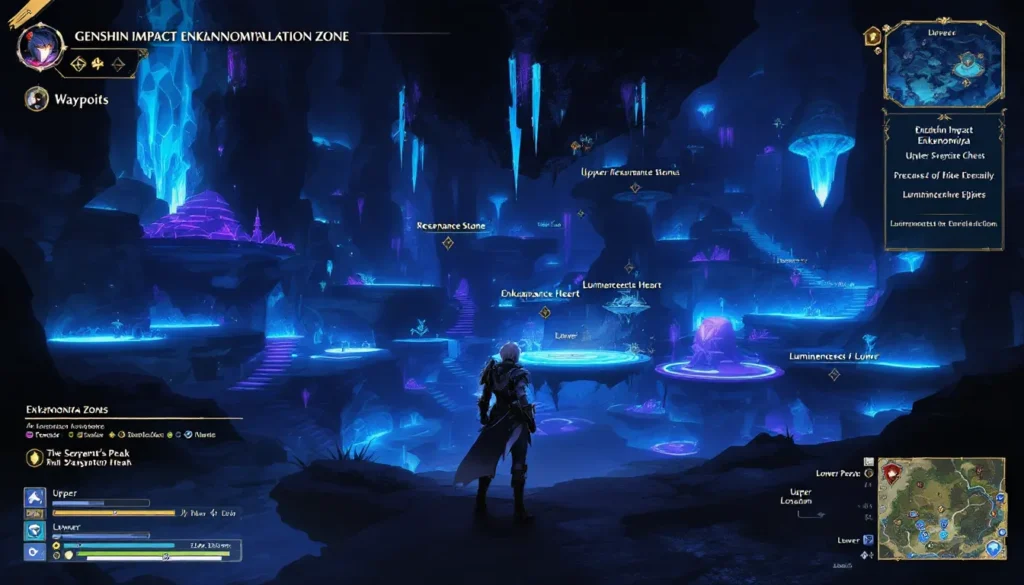
The Upper and Lower Districts
Enkanomiya is divided into two primary vertical zones: the Upper District (Evernight Temple area) and the Lower District (The Serpent’s Heart and beyond). The Upper District serves as your entry point, it’s where you’ll surface from the Chasm and find the first anchors, waypoints, and initial treasure. This zone is more open, with wider platforms and easier navigation. You’ll encounter lighter enemy densities here and find introductory puzzles that teach Enkanomiya’s unique mechanics.
The Lower District is where things get serious. Descending deeper reveals more complex layouts, denser enemy clusters, and harder puzzles tied to the Namecard system and Resonance Stone mechanics. The lowest depths present some of the region’s toughest encounters and most rewarding chests. Expect longer travel times and more environmental hazards, falling off platforms can force backtracking, and certain areas flood or shift based on puzzle solutions.
The vertical distance between districts is significant. Smart waypoint usage becomes critical: fast-traveling to the highest available waypoint saves substantial time when farming or exploring. Teleport points scattered throughout Enkanomiya act as your lifeline, unlocking all of them early should be a priority.
Key Landmarks and Points of Interest
Several major landmarks define Enkanomiya’s geography:
The Serpent’s Heart sits at the lowest accessible point, housing one of the region’s most important World Quests and containing rare treasures. This area demands careful enemy management and patience, rushing leads to deaths and wasted time.
The Evernight Temple occupies the upper-middle zone, dense with puzzles tied to the Resonance Stones. This temple connects multiple vertical layers and contains numerous hidden chests rewarding thorough exploration.
The Narrows is a narrower passage connecting upper and lower zones. Enemy encounters here feel claustrophobic, making ranged or AoE-focused teams valuable.
The Shirakoro Peak sits on the eastern side, offering scenic overlooks and puzzle-heavy treasure hunts. This area’s puzzles often require specific element interactions, so diverse team compositions are essential.
Musoujin Gorge challenges explorers with environmental hazards and tightly packed enemy groups. This zone rewards aggression, burst damage compositions excel here.
Each landmark has associated chests, puzzles, and enemy encounters. Mentally mapping these locations prevents aimless wandering and keeps your farming sessions efficient.
Getting Started: Access and Prerequisites
Required Adventure Rank and Quests
Enkanomiya isn’t immediately accessible when you start Genshin Impact. The region requires Adventure Rank 30 minimum to unlock, though HoYoverse strongly recommends Adventure Rank 40+ before serious exploration attempts. Your first entry happens through the Chasm, a surface region north of Liyue.
To actually access Enkanomiya, you must complete the World Quest “The Seaborne” sequence. This series of quests is mandatory and serves as the region’s introductory narrative. The questline explains the lore, teaches you how Enkanomiya’s unique mechanics function, and guides you through your first descent. Don’t skip these quests, they’re short, narratively important, and provide context for everything you’ll encounter below.
After completing the intro quests, the region opens fully. But, certain deeper areas and advanced quests have additional requirements. Some World Quests unlock only after completing specific prerequisite quests, and a few optional areas require solving environmental puzzles before you can access them. Read quest descriptions carefully: Genshin Impact provides subtle hints about what you need to progress.
Your team composition matters more in Enkanomiya than in many other zones due to the region’s verticality and specific puzzle types. Before descending for serious exploration, ensure you have at least one leveled healer and a strong DPS carry. [Genshin Impact Guide: Essential Tips for New and Returning Players covers broader team-building fundamentals that apply directly to Enkanomiya expeditions.
Navigation Tips for New Explorers
Enkanomiya punishes poor navigation. Here’s what separates efficient explorers from wanderers:
Unlock waypoints aggressively. Each waypoint you activate reduces future travel time. Spend your first 30 minutes purely unlocking teleport points, don’t worry about chests yet. Fast-traveling between waypoints beats sprinting across platforms every time.
Use the map constantly. Enkanomiya’s layout is confusing initially. Keep your map open, mark waypoints and interesting locations, and reference it constantly. The game’s map system highlights undiscovered areas in dark colors, use this to target unexplored regions methodically.
Manage stamina carefully. Gliding downward costs stamina, and falling without gliding damages your health. Stamina consumables and characters with reduced stamina costs (like Kazuha) become valuable. Plan your vertical traversal in advance rather than improvising mid-jump.
Pay attention to environmental storytelling. Ancient tablets, murals, and NPC dialogue provide context clues about where treasures hide and how puzzles function. Players who read these environmental cues find secrets faster than those who ignore them.
Group enemies strategically. Don’t fight every enemy you see. Understand mob placements, some areas have clustered enemies while others have isolated enemies. Knowing this lets you plan efficient farming routes, fighting only the packs worth your time.
Collectibles and Treasures
Chests and Hidden Loot Locations
Enkanomiya contains 79 chests in total, a mix of Common, Exquisite, and Precious chests scattered across the region. Each chest type drops different reward quantities:
- Common Chests: Award smaller quantities of Mora and common materials
- Exquisite Chests: Provide decent Mora and occasionally Primogems
- Precious Chests: The holy grail, containing the most Primogems and high-rarity materials
Finding all 79 chests requires systematic exploration. Many hide in obvious locations, on platforms visible from main paths, but plenty conceal themselves in vertical alcoves, behind destructible walls, or underwater in flooded chambers. The trick is patience and vertical awareness.
Key chest clusters appear near:
- The Serpent’s Heart: Approximately 12-15 chests in and around this central landmark
- Evernight Temple: Dense chest concentration, often tied to puzzle solutions
- Shirakoro Peak: Scenic area with chests rewarding thorough exploration of cliffs and overlooks
- Musoujin Gorge: Enemy-heavy zone with chests as combat rewards
A systematic approach beats random wandering. Start at the highest elevation, work your way down, and use waypoints to avoid backtracking. Mark opened chests on your map to prevent re-opening the same ones.
Puzzles and Their Rewards
Enkanomiya’s puzzles are more complex than surface-world puzzles, often requiring element interactions or multi-step solutions. The Resonance Stones are central to Enkanomiya’s puzzle design, these glowing objects shift environmental properties and unlock hidden areas.
Common puzzle types include:
Resonance Stone Sequences: Activate stones in a specific order to unlock doors or create platforms. Trial-and-error works, but observing environmental hints (stone colors, positioning) speeds solutions.
Elemental Interaction Puzzles: Certain obstacles require specific elements, use Pyro to ignite barriers, Hydro to activate water mechanisms, Electro to power devices. Teams with diverse elements solve these faster. As [Genshin Impact Examples: A Guide to Key Gameplay Elements demonstrates, understanding how game systems interconnect reveals puzzle solutions more intuitively.
Pressure Plate Sequences: Stand on plates in timed patterns to open chests or passages. These often require multiple characters, coordinate with your team.
Environmental Hazards: Flooded chambers, lava flows, and darkness all pose obstacles. Specific puzzles require managing these hazards, turning off darkness zones, draining floods, or cooling lava.
Most puzzles reward chests or unlock new areas. The Primogem payoff for solving puzzles makes them worth your time, each puzzle typically nets you one Precious or Exquisite chest.
Luminescent Spines and Echoing Conches
Luminescent Spines are floating, glowing collectibles scattered throughout Enkanomiya. They serve no functional purpose but contribute to achievement completion and provide satisfaction for completionists. There are 40 Luminescent Spines total. Collecting all of them doesn’t net you Primogems directly, but it’s a good secondary objective while exploring.
Echoing Conches are audio collectibles, listening to them plays ambient environmental storytelling relevant to Enkanomiya’s lore. Like Luminescent Spines, they contribute to exploration achievements. There are 33 Echoing Conches across the region. They’re easier to find than spines because they’re usually audible, listen for faint whale songs or ancient voices while exploring.
Neither collectible is mandatory, but players seeking 100% completion status hunt them systematically. Many players combine Spine/Conch hunting with chest looting to maximize efficiency, while traveling between treasures, you’ll naturally encounter these optional collectibles.
Combat Encounters and Enemies
Common Enemy Types and Strategies
Enkanomiya reuses enemy types from other regions but groups them more densely, creating genuine combat pressure. The region lacks environmental advantages like high ground or wide-open spaces, most fights occur in tight corridors or confined platforms. This changes approach from surface combat significantly.
Hilichurls and Slimes remain the weakest enemies. They pose minimal threat but can distract your team and waste time. Focus damage to eliminate them quickly.
Ruin Hunters and Ruin Guards appear frequently in the lower districts. These mechanical enemies have high HP pools and deal consistent damage. Electro-based DPS excels against them, but any strong carry can handle them with proper rotation. Interrupt their charged attacks using crowd control abilities.
Fatui Agents patrol Enkanomiya, reflecting the region’s lore ties to the Fatui organization. These enemies have elemental shields matching their type, bring appropriate counters. Cryo Agents are most common: Pyro application breaks their shields fastest.
Specters float in upper districts. These airborne enemies can’t be reached by melee characters easily. Ranged DPS or characters with elevated attacks (Hu Tao, Alhaitham) handle them better than pure sword users. Crowd control helps ground them.
Abyss Lectors and Abyss Herald are endgame enemies found in the deepest regions. These Abyss-affiliated foes have high HP, elemental shields, and attack patterns demanding respect. Team composition matters here, bring strong healers and proper element counters. These fights showcase why proper leveling matters before deep exploration attempts.
Strategy varies by zone. In dense areas, use AoE abilities to cluster damage. In tight corridors, position characters to prevent kiting. Always maintain healer uptime, overhealing beats emergency recoveries in Enkanomiya’s constrained environments.
Boss Battles and Unique Challenges
Enkanomiya features two significant boss encounters tied to World Quests:
The Bathysmal Vishap Herd is a group boss fight occurring in the lower-middle districts. You face multiple Vishaps simultaneously, these aquatic creatures have high mobility and unpredictable attack patterns. They hit hard but have obvious openings. Burst-heavy teams excel: focus damage on one Vishap to reduce enemy numbers quickly. Healing and crowd control are your MVPs here.
Osial, the Overlord of the Vortex appears in Enkanomiya’s deepest quest sequence. This elder-level enemy demands precise execution. Osial has multiple phases, elemental damage patterns, and attack combinations that punish poor positioning. Most players need high-investment teams (level 80+, good artifacts) to defeat Osial without struggling. Bring your strongest DPS pair and a dedicated healer. This fight tests whether your account investment translates to combat readiness.
Beyond these boss quests, environmental encounters include elite enemies like Geovishaps and Ruin Destroyers in thematic locations. These aren’t technically “bosses” but hit with boss-level damage. Treat them with respect, rushing these fights results in failed explorations.
The difficulty spike from surface exploration to Enkanomiya combat is intentional. HoYoverse uses Enkanomiya to pressure players into proper character investment. If you’re struggling with standard Enkanomiya encounters, your team level or artifact quality needs work. Don’t blame the zone, upgrade your characters. [How to Play Genshin Impact: A Beginner’s Guide covers fundamental character development principles that directly impact combat readiness in challenging zones.
Quests and Lore Exploration
Main and Side Quests in Enkanomiya
Enkanomiya features 15+ World Quests exploring the region’s history and lore. These aren’t traditional quests with marked objectives, instead, they’re narrative journeys where you discover story context through exploration and observation.
The Seaborne sequence introduces Enkanomiya and its mechanics. This mandatory questline is short but essential for understanding why this region exists and what happened to it. Completion nets Primogems and unlocks further exploration.
The First Disciple series expands the lore significantly, connecting Enkanomiya to broader Genshin Impact narrative threads involving Celestia and the Abyss. These quests are longer, often requiring puzzle-solving and combat encounters. Completion rewards substantial Primogems, definitely worth your time.
The Second Disciple and The Third Disciple continue the narrative, each introducing new story elements and combat challenges. These quests are spread across Enkanomiya’s geography, encouraging exploration of areas you might otherwise miss.
Other notable quests include investigations of specific monuments, explorations of ancient technology, and encounters with NPCs who provide historical context. Each quest contributes pieces to Enkanomiya’s overarching narrative.
Completion rewards are consistent:
- Primogems (20-40 per quest)
- Adventure EXP
- Occasional Shrine of Depths keys
- Lore fragments contributing to understanding
Don’t rush World Quests. Read dialogue, observe environmental context, and let the narrative breathe. Enkanomiya’s story is among Genshin Impact’s best, missing it because you speed-ran defeats the purpose.
Character Hangout Events
Enkanomiya hosted unique Hangout Events for specific characters, particularly those with narrative ties to the region. These events are limited-time content (usually lasting 2-3 weeks during active versions), but permanent records remain for returning players.
Hangout Events feature branching dialogue and story paths where your choices influence outcomes. They provide character development, reveal personality sides not shown in main quests, and offer Primogems upon completion (typically 20-40 per event).
Characters featured in Enkanomiya hangouts include those with canonical connections to the region’s lore. Completing these events provides both entertainment and rewards, it’s free Primogems tied to engaging storytelling.
The World Quest Experience
Enkanomiya’s World Quests exemplify Genshin Impact’s environmental storytelling. Rather than NPCs explicitly telling you what to do, the zone itself guides you through observation. Broken structures suggest what happened, murals show historical events, and NPC monologues provide context clues.
This design rewards attention. Players who casually sprint through Enkanomiya miss these narrative details. Players who explore slowly, read tablet translations, and observe environmental context absorb a richer story. For completionists and lore enthusiasts, Enkanomiya is essential.
The quest structure also encourages replaying regions. Unlike traditional quests with failed states, World Quests can be experienced repeatedly, if you miss context on first attempt, returning solves it. This flexibility means exploration never feels wasted even if you take wrong paths.
Enkanomiya’s World Quests prove that Genshin Impact’s best content combines exploration, combat, storytelling, and puzzle-solving. Approaching these zones purely for Primogem farming misses what makes them compelling. [Genshin Impact for Beginners: A Complete Starter Guide emphasizes that newer players underestimate how rich Genshin Impact’s world design is, Enkanomiya exemplifies this depth.
Practical Exploration Strategies
Best Characters and Team Compositions
Enkanomiya’s environment and enemy density favor specific team archetypes. Rather than one “best” team, optimal compositions depend on whether you’re farming, exploring, or questing.
Exploration-Focused Teams prioritize mobility and convenience:
- Kazuha or Venti (sub-DPS/Crowd Control): Reduced stamina costs and grouping abilities save time traversing vertical zones
- Nahida (Sub-DPS/Dendro): Excellent off-field Dendro application simplifies elemental puzzles
- Zhongli (Shield Support): His shield eliminates environmental damage concern, letting you focus on navigation
- Bennett or Fischl (Sub-DPS): Consistent off-field damage acceleration
This team gets you everywhere, solves puzzles reliably, and handles random encounters without swapping characters.
Farming-Focused Teams maximize damage efficiency:
- Hu Tao or Alhaitham (Main DPS): High single-target or AoE damage clears enemy clusters fast
- Fischl or Nahida (Sub-DPS): Consistent off-field damage amplification
- Zhongli or Barbara (Support): Shield or healing depending on your comfort level
- Kazuha (Elemental Amplifier): Boosts your DPS’s elemental damage significantly
This team obliterates enemy groups, making resource farming sessions quick.
Puzzle-Solving Teams bring elemental diversity:
- Pyro applicator (Bennett, Amber, or main DPS carrying Pyro)
- Hydro applicator (Yelan, Xingqiu, or Hydro DPS)
- Electro applicator (Fischl, Nahida, or Electro DPS)
- Cryo applicator (Shenhe, Ganyu, or Cryo DPS)
Rotating these characters as-needed handles all puzzle types without forcing suboptimal teams.
The reality: any strong leveled team clears Enkanomiya. If your main team handles overworld domains, it handles Enkanomiya. Character level (80+), artifact quality (good 5-star artifacts minimum), and talent investment (level 8+ important abilities) matter more than specific characters.
Resource Farming Efficiency
Enkanomiya offers excellent grinding spots if you approach farming methodically:
Enemy Farming Routes: Pre-plan your mob path, hitting clusters in sequence. The Musoujin Gorge has dense Ruin Hunter/Guard concentrations. Clear them, fast-travel to the nearest waypoint, repeat. This nets steady Mora, ascension materials, and talent materials.
Material Spawning: Certain locations spawn gathering materials like Lakelight Lilies (Yelan ascension) and Pseudo-Conches (ascension materials for other characters). These respawn every 2-3 days (server-dependent). Mark their locations and farm them on resin-free days.
Puzzle Farming: Solving repeatable puzzles grants chests, which drop Mora. The Evernight Temple has particularly chest-dense puzzle sequences. This isn’t pure farming but combines enjoyment with reward.
Ley Line Outcrops: Enkanomiya contains Ley Line Blossoms (Daily Domains) providing Mora or talent materials. These cost Resin but return excellent value. Farming these efficiently on reset days maximizes resource gain.
Optimal farming sessions combine several approaches. Spend 20 minutes hunting enemies, 15 minutes gathering materials, 10 minutes solving puzzle sequences, then tackle a Ley Line if you have Resin. This varied approach prevents boredom while maintaining efficiency.
Common Mistakes to Avoid
Mistake 1: Not unlocking waypoints first. Players who ignore waypoints waste massive time traveling. Unlock all accessible waypoints before serious exploration, it’s the single biggest efficiency gain.
Mistake 2: Fighting every enemy. Not every mob needs defeating. Skipping insignificant enemies and focus-clearing valuable targets (for drops) saves time and resources.
Mistake 3: Ignoring the map. Enkanomiya’s layout confuses new players because they don’t reference their map constantly. Get comfortable with map navigation immediately.
Mistake 4: Under-leveling for depth exploration. The lower districts have genuinely tough enemies. If your team is below level 60, you’ll struggle. Prepare appropriate levels before attempting Serpent’s Heart or Osial encounters.
Mistake 5: Rushing quests for Primogems. Enkanomiya’s storytelling is excellent. Rushing quests misses context and ruins the experience. Play at a comfortable pace.
Mistake 6: Neglecting healer leveling. Many players skip healer investment, then regret it in Enkanomiya’s damage-heavy encounters. A leveled healer (Barbara at level 60+, Zhongli shield, or Bennett at 70+) transforms difficulty perception.
Mistake 7: Not bringing puzzle-appropriate elements. Showing up to puzzle zones without Hydro or Pyro characters forces unsatisfying workarounds. Bring varied elements.
Most mistakes stem from rushing. Enkanomiya rewards patience and methodical approaches. Slower exploration actually completes faster than panicked attempts. [Genshin Impact Tips: Essential Strategies for New and Returning Players reinforces this principle, proper planning beats chaotic execution consistently. Also, exploring Enkanomiya’s recent evolution, [Genshin Impact Trends 2026: What to Expect This Year, mentions how resource farming in established regions like Enkanomiya continues feeding into long-term progression goals.
Conclusion
Enkanomiya stands as one of Genshin Impact’s finest exploration zones, rewarding methodical players while challenging the unprepared. Its vertical design, interconnected puzzle systems, and narrative depth elevate it beyond basic content, it’s a full experience combining all of Genshin Impact’s best mechanical and storytelling elements.
Approaching Enkanomiya with a solid team, proper waypoint unlocking, and patience transforms potential frustration into genuine enjoyment. The zone’s 79 chests, World Quests, and environmental storytelling justify extended exploration. Whether you’re optimizing for Primogems, farming resources, or absorbing lore, Enkanomiya delivers across all approaches.
The 2026 version of Enkanomiya remains relevant and rewarding. As HoYoverse continues evolving Genshin Impact, established regions like Enkanomiya maintain value through consistent resource availability and permanent narrative content. Don’t overlook this zone as “old content”, it’s foundational to understanding Genshin Impact’s world and acquiring materials for new characters.
Start with the fundamentals: unlock waypoints, gather basic treasures, complete mandatory quests. Progression builds naturally from there. Months later, you’ll return having discovered secrets you missed on first exploration, that’s the mark of excellent zone design. Enkanomiya isn’t something you finish: it’s something you gradually master.