Table of Contents
ToggleThe Nintendo 64 changed home gaming forever. Released in 1996, this console introduced millions of players to 3D gaming and created memories that still resonate today. But what is Nintendo 64 exactly, and why does it hold such a special place in gaming history?
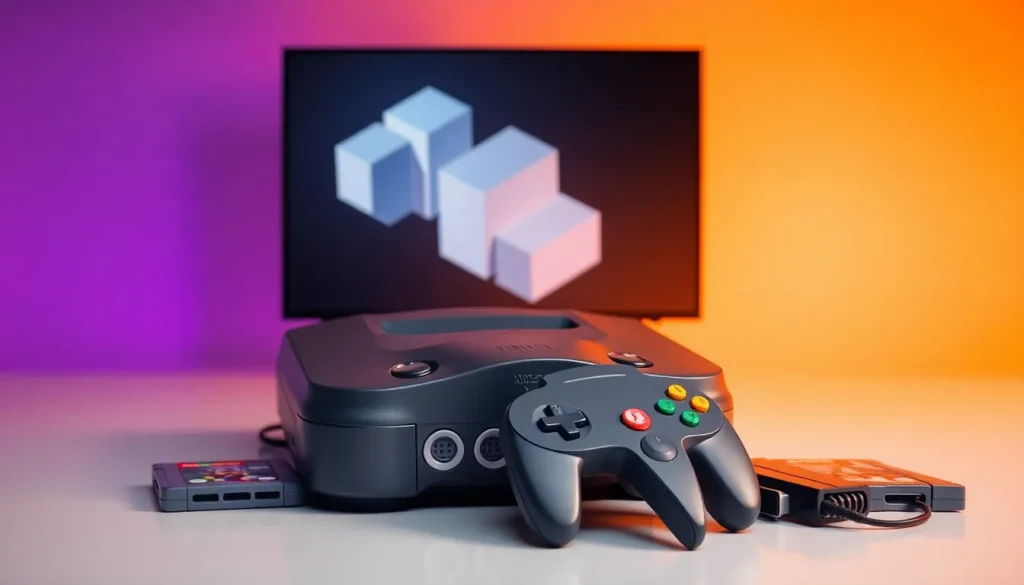
The Nintendo 64, often called the N64, was Nintendo’s fifth-generation home console. It competed directly with the Sony PlayStation and Sega Saturn. The console earned its name from its 64-bit central processing unit, a significant leap from its 16-bit predecessor, the Super Nintendo Entertainment System. This guide covers everything from the Nintendo 64’s launch to its lasting impact on the gaming industry.
Key Takeaways
- The Nintendo 64 is Nintendo’s fifth-generation home console, released in 1996, named after its powerful 64-bit processor.
- The N64 pioneered the analog stick and rumble feedback, features now standard in all modern gaming controllers.
- Iconic games like Super Mario 64, Ocarina of Time, and GoldenEye 007 set design standards that developers still follow today.
- Nintendo’s decision to use cartridges instead of CDs eliminated load times but limited game storage and increased production costs.
- The Nintendo 64’s built-in four controller ports made it the ultimate multiplayer console, creating legendary party gaming experiences.
- Despite selling 32.93 million units—less than PlayStation—the Nintendo 64’s cultural impact and legacy continue through retro gaming communities and Nintendo’s Switch Online service.
The History and Launch of the Nintendo 64
Nintendo developed the Nintendo 64 under the codename “Project Reality” in partnership with Silicon Graphics Inc. (SGI). The collaboration aimed to bring arcade-quality graphics into living rooms. Development began in 1993, and the project generated massive hype among gamers.
The Nintendo 64 launched in Japan on June 23, 1996. North America received the console on September 29, 1996, with a retail price of $199.99. Europe and Australia followed in March 1997. The system sold over 500,000 units in its first four months in North America alone.
Nintendo made a bold choice by sticking with cartridges instead of switching to CD-ROMs like Sony and Sega. This decision had pros and cons. Cartridges loaded games almost instantly and were harder to pirate. But, they cost more to produce and held less data than CDs. This limitation meant smaller games and fewer full-motion video sequences compared to PlayStation titles.
The Nintendo 64 arrived during an intense console war. Sony’s PlayStation had already established a strong foothold in the market. Even though the competition, the N64 carved out its own loyal fanbase through exclusive titles and innovative hardware.
Key Features and Technical Specifications
The Nintendo 64 packed impressive hardware for its time. Its 64-bit NEC VR4300 CPU ran at 93.75 MHz. The console featured 4 MB of unified RAM, which Nintendo later expanded to 8 MB with the Expansion Pak accessory.
The graphics processing unit delivered capabilities that stunned players in 1996. The Reality Coprocessor handled texture mapping, Z-buffering, and anti-aliasing. These features produced smooth 3D environments that few home consoles could match at launch.
Nintendo introduced the revolutionary N64 controller alongside the console. This three-pronged gamepad featured:
- An analog stick for precise 3D movement
- A trigger button (Z button) on the back
- Four C buttons for camera control
- A slot for accessories like the Rumble Pak
The analog stick proved groundbreaking. It gave players fine control over character movement, essential for 3D platformers and adventure games. Sony and other competitors quickly adopted similar designs.
The Nintendo 64 supported four controller ports built into the console. This feature made the N64 the go-to system for multiplayer gaming. Friends could plug in and play without buying additional adapters. Games like GoldenEye 007 and Mario Kart 64 became legendary party experiences because of this design choice.
Cartridge capacity ranged from 4 MB to 64 MB. While limited compared to CDs, this storage worked well for gameplay-focused titles. The format also eliminated load times, keeping players immersed in the action.
Iconic Games That Defined the N64 Era
The Nintendo 64 library includes some of the most influential games ever made. These titles pushed boundaries and set standards that developers still follow today.
Super Mario 64 launched alongside the Nintendo 64 and redefined platforming. It translated Mario’s gameplay into 3D with precision and creativity. Players explored Princess Peach’s castle and collected Power Stars across diverse worlds. The game sold over 11 million copies and established templates for 3D game design.
The Legend of Zelda: Ocarina of Time arrived in 1998 and earned universal acclaim. Many critics and players consider it one of the greatest games ever created. Its Z-targeting system solved the problem of combat in 3D spaces. The game featured a vast world, memorable dungeons, and a story that moved players emotionally.
GoldenEye 007 proved that first-person shooters could thrive on consoles. Developed by Rare, this James Bond adaptation featured tight single-player missions and addictive four-player split-screen multiplayer. It sold over 8 million copies and influenced countless shooters that followed.
Mario Kart 64 became the definitive party game of its generation. Four players could race simultaneously, leading to friendships tested and rivalries born. The game introduced iconic tracks like Rainbow Road and perfected the kart racing formula.
Other essential Nintendo 64 titles include:
- Super Smash Bros. – Nintendo’s crossover fighting game phenomenon
- Banjo-Kazooie – A collect-a-thon platformer with charm and challenge
- Perfect Dark – GoldenEye’s spiritual successor with advanced features
- Star Fox 64 – Intense space combat with memorable voice acting
- Paper Mario – A creative RPG spin on the Mario franchise
These games demonstrated what the Nintendo 64 could achieve. They combined technical innovation with excellent game design.
The Legacy and Impact of Nintendo 64 on Gaming
The Nintendo 64 sold approximately 32.93 million units worldwide during its lifespan. While this number fell short of the PlayStation’s 102 million, the N64’s cultural impact far exceeded raw sales figures.
The console pioneered several gaming conventions. The analog stick became standard on all controllers that followed. Rumble feedback, introduced through the Rumble Pak, is now expected in every modern gamepad. Four-player local multiplayer on the Nintendo 64 created social gaming experiences that defined a generation.
Nintendo 64 games established design principles still used today. Super Mario 64’s camera system influenced every 3D platformer since. Ocarina of Time’s lock-on targeting appears in action games from Dark Souls to modern Zelda entries. GoldenEye 007 proved console shooters could compete with PC titles.
The retro gaming community keeps the Nintendo 64 alive. Original consoles and cartridges command high prices from collectors. Titles like Conker’s Bad Fur Day and some rare variants sell for hundreds of dollars. Nintendo has also re-released N64 games through its Switch Online Expansion Pack service.
Emulation and fan communities preserve the Nintendo 64 legacy too. Projects restore and enhance classic games for modern systems. Speedrunners continue breaking records in N64 titles decades after release.
The console’s influence extends beyond gaming. The Nintendo 64 shaped the childhoods of millions. Its games created shared experiences that people still discuss and celebrate. For many, asking “what is Nintendo 64” sparks memories of late-night multiplayer sessions and weekend adventures.